
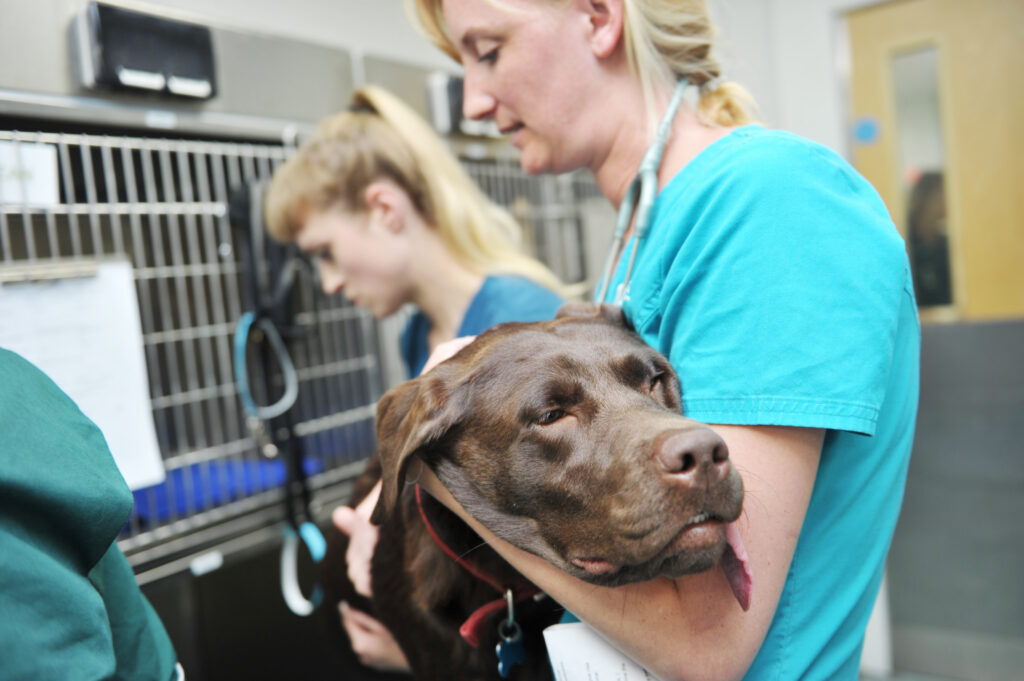
In this blog for Veterinary Nursing Awareness Month, BVNA Council Member Macauly Gatenby discusses how learning from his own grief has allowed him to truly value and understand how others can be supported when losing a pet.
Find out more about VNAM here, and how you can get involved this year.
As RVNs we are often there for the final moments of a loved pet’s life. We know how to communicate or appropriately and professionally alter the way we communicate to show the right degree of empathy and compassion. It is often a fine tuned skill that we learn whilst we are training. However, it was not until as a caregiver I truly valued and understood how I wanted to be supported.
March 2024 was quite honestly the worst time of my life, losing a pet, a loved one, a core family member is gut wrenching, let alone when it happens unexpectedly. I often think as veterinary professionals we are our worst enemy, all of our training and knowledge seems to go out of the window. I felt like the building blocks of who I was crumbled away and I wasn’t able to reconnect the pieces, no matter how hard I tried. Lacey, my beloved Jack Russell, who had been through my later teenage years and into my adult life, had gone. She was there through monumental moments in my life, both good and bad. I associate her with all my nieces and nephews as she was there for all of their births and first birthdays. She helped assist me with night feeds of my hand-reared kittens, overlooking and making sure I was doing it all correctly. How was I going to be able to nurse or care for another animal, let alone another Jack Russell? Little did I know, losing my own would give me the strength and ability to improve my own compassion and empathy for not only my patients but their caregivers. It gave me a point of view I wasn’t expecting. I truly believe no amount of training can top the lived experience that allowed me to understand what someone may truly want or need by their subtle mannerisms or phrases they may use.
You see, when Lacey died I wasn’t with her, I asked my family to take her to another veterinary practice as I couldn’t possibly bear my colleagues, close friends being the ones to assist her with end of life. I couldn’t possibly allow my brain to associate her death with them, even though I knew they would be compassionate and empathetic to not only Lacey but my family members and myself.
One thing I want veterinary professionals to think about and understand when the time comes for someone’s pet, is to be compassionate and show empathy to every euthanasia. The bond someone has with their pet is unique and only they truly understand it. Be empathetic to those that do not want to be with their loved ones, it isn’t abandoning them, we are there to provide and support treatment options. We often forget the power of this treatment option. I also want people to be compassionate to the decision they’ve just made moments before, they may have left the room but a piece of them is going with that loved individual. We remember the aftercare of euthanasia, the pawprint, the fur clipping and making sure the correct cremation choice has been made. However, we perhaps may forget about the importance of showing empathy through the end of life care. The owner and family may want to be in the room, but whatever decision they make we need to be supportive and caring in that situation. I still grapple with the “should have” and “could have” with the decision of not being with Lacey when she left. I know it was the right decision in order for me to move forward with my grief, that will never diminish my bond with Lacey. Because I knew my family members who were with her needed it more than I did at that moment.
Lacey still lives on with me, and as if it were meant to be, I adopted Twiglet a year and one day after the anniversary of her passing. Funnily enough through someone called Lacey. She is by no means a replacement but she certainly has helped heal a part of me that went with her. So my take home messages are: be kind and be present for both the patient and the caregiver, be compassionate with their bond and love, and to be empathetic through all end of life support regardless of the caregiver’s decisions.
Macauly Gatenby, BVNA Council Member
