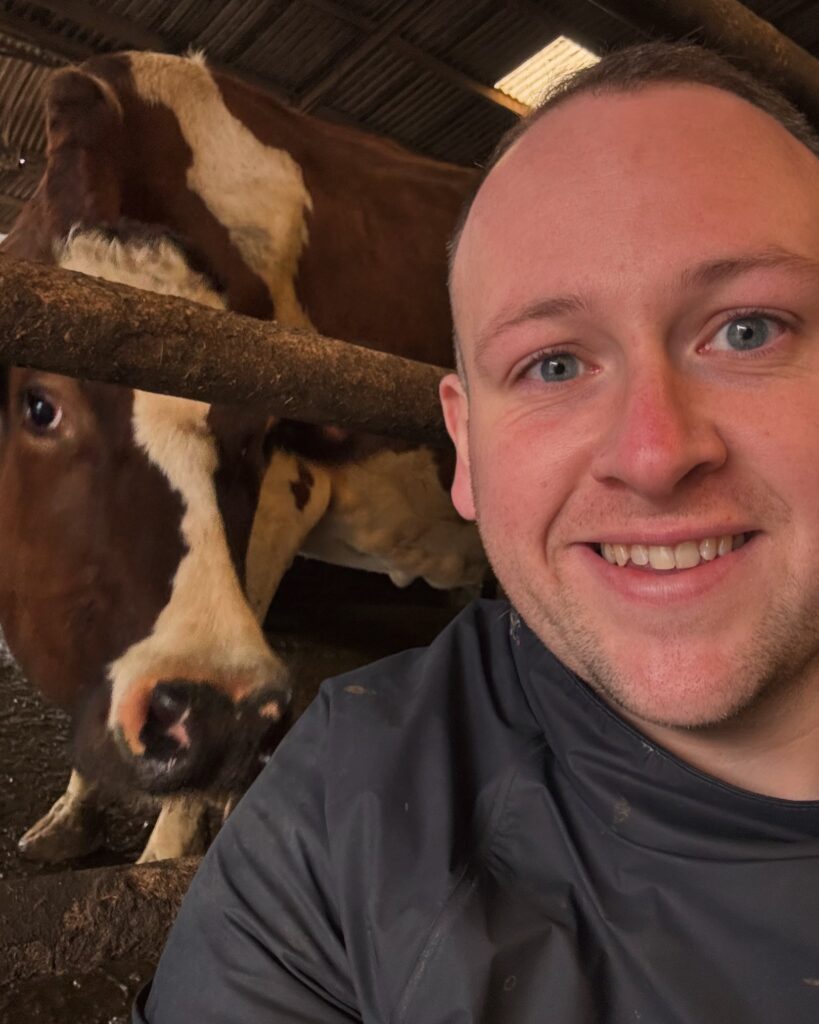
In this blog for Veterinary Nursing Awareness Month, BVNA Council Member Dan Lidgbird shares insight into the ever-changing role of a farm RVN and how compassion in farm practice carries a unique depth.
Find out more about VNAM here, and how you can get involved this year.
When people think of veterinary nursing, they often picture the small animal clinic – bright consult rooms, wagging tails, recovery wards filled with blankets and careful monitoring. But beyond those clinic walls, across rolling fields and inside busy farmyards, another group of veterinary nurses are making an equally profound impact.
During Veterinary Nursing Awareness Month, we also celebrate the Registered Veterinary Nurses working in farm animal practice – professionals whose compassion and empathy are woven into every aspect of their role.
A Farm RVN’s day rarely looks the same twice. It may begin before sunrise, travelling between farms as mist hangs low over the fields. It may involve assisting with a difficult calving, monitoring post-operative recovery in a dairy herd, supporting flock health planning, or helping implement preventative medicine protocols. The work is skilled, practical, and often physically demanding.
Yet what truly defines a Farm RVN is not just clinical competence – it is heart.
Compassion in farm practice carries a unique depth. Livestock are part of food production systems, but they are also sentient animals deserving of dignity and high welfare standards. Farm RVNs operate within this delicate balance every day. They handle animals with patience and care, minimise stress wherever possible, and advocate quietly but persistently for best practice in pain management, housing, and preventative health.
Empathy extends beyond the animals.
Farming is more than an occupation; it is often a family legacy, shaped by long hours, financial pressures, unpredictable weather, and disease risks that can change everything overnight. Farm RVNs frequently stand beside farmers during some of their most challenging moments – herd disease outbreaks, difficult prognoses, or the decision to euthanise a valued animal.
In these moments, technical knowledge alone is not enough. What matters is the ability to listen without judgement, to communicate clearly and kindly, and to recognise the emotional weight behind practical decisions. Trust is built slowly in rural communities. It grows through consistency, reliability, and genuine care. A Farm RVN may become a familiar and reassuring presence – someone who understands both herd health targets and the human realities behind them. That relationship is a partnership, grounded in shared goals: healthy animals, sustainable farming, and responsible stewardship.
The emotional landscape of farm practice can be complex. There are early-morning emergencies in freezing weather, long days on foot, and the ethical challenges that accompany production animal medicine. Compassion does not mean being unaffected by these experiences; it means choosing to approach them with integrity and care.
And like all areas of veterinary nursing, farm practice requires resilience. Supporting others – both animals and people – also means recognising the importance of self-care and peer support within the profession.
Veterinary Nursing Awareness Month is an opportunity to bring visibility to this often-unseen work. There may be no waiting room cuddles or social media snapshots, but there are muddy boots, steady hands during calvings, thoughtful herd health conversations, and countless small actions that improve animal welfare every single day.
To be a Farm RVN is to stand at the intersection of science, agriculture, welfare, and humanity.
It is to care deeply – not only for the animals in your charge, but for the people whose livelihoods depend on them.
This month, we honour the compassion and empathy that define farm veterinary nursing. The dedication may not always be visible to the wider public, but its impact is felt across fields, farms, and rural communities everywhere.
Dan Lidgbird, BVNA Council Member